Volkswagen ID.4: Hazard classification of high-voltage system
Volkswagen ID.4 (E21) 2021-2026 Service Manual / Electric drive EIP220, EIA200, EIA210 /
Technical data / Hazard classification of high-voltage system
Hazard classification for high-voltage system
DANGER
The vehicle's high-voltage system and the high-voltage battery
are dangerous components that can cause burns or other
injuries and even lead to a fatal electric shock.
- Any work on the high-voltage system, or on systems which
could be indirectly affected by it, may only be carried out
by properly trained and qualified expert personnel.
- In the event of queries or uncertainties regarding the terms
"high-voltage technician" or "high-voltage expert", or those
concerning the high-voltage system, the responsible importer
must be contacted prior to the commencement of
any work.
- Repair work must always be carried out in accordance
with applicable laws and regulations, the state-of-the-art
technology, any relevant accident prevention regulations
(in Germany, including but not limited to the Information of
the German Social Accident Insurance (DGUV) 209-093 -
Qualification training for work on vehicles with high-voltage
system), as well as this workshop manual.
- Only the HVT is authorised to certify that the high-voltage
system has been de-energised.
- All work measures necessary for the vehicle may only be
carried out by a person qualified to at least the level of
electrically instructed person (EIP).
- Regardless of the work to be performed, visually inspect
high-voltage components in the work area.
- High-voltage cables must not be overly bent or kinked.
- In the event of conspicuous findings or uncertainties, the
high-voltage technician (HVT) or the high-voltage expert
(HVE) must be consulted.
- Any work involving metal-removing, deforming and sharpedged
tools or heat sources such as welding, soldering, hot
air, thermal bonding and infrared drying in the vicinity of
high-voltage components and cables is prohibited. In this
case the high-voltage system must be de-energised and the
respective component removed or sufficiently protected.
- All listed work refers to the removal and installation or the
renewal of the individual components.
- For regular maintenance work, the high-voltage system does
not have to be de-energised.
For reasons of safety, the following activities must not be carried
out during charging:
- Activities that prolong the charging process.
- Activities for which the vehicle must be de-energised and
made safe in accordance with the ensuing hazard rating.
- Activities during which the vehicle is moved and electrical
wires and connectors could be placed under strain (pulled).
- Activities during which the connected charging cable could
present a danger of tripping and injury.
- Activities during which the charging cable could block work
paths and emergency exit routes.
- Activities on the 12V battery
The following activities may be carried out with the ⇒ Vehicle
diagnostic tester during charging:
- The event memory and measured values may be read.
- The vehicle and control units may be identified.
Important
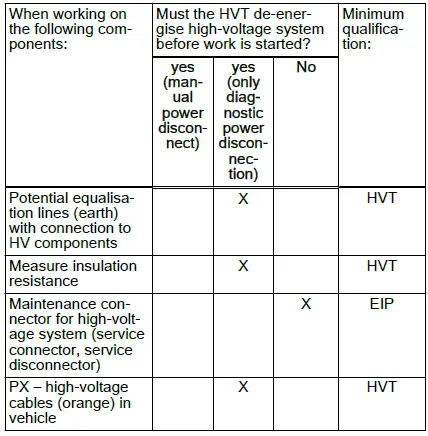
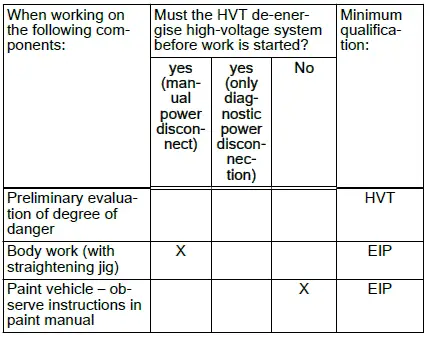
- Before work is carried out on the following components, the
system must be de-energised by a high-voltage technician
(HVT) or a high-voltage expert (HVE).
Work on high-voltage system
Work on accident vehicles
Volkswagen ID.4 (E21) 2021-2026 Service Manual
Explore moreFeatured ID.4 Guides
Selected owner and service information from our Volkswagen ID.4 manual library.
 ID.4 Guide
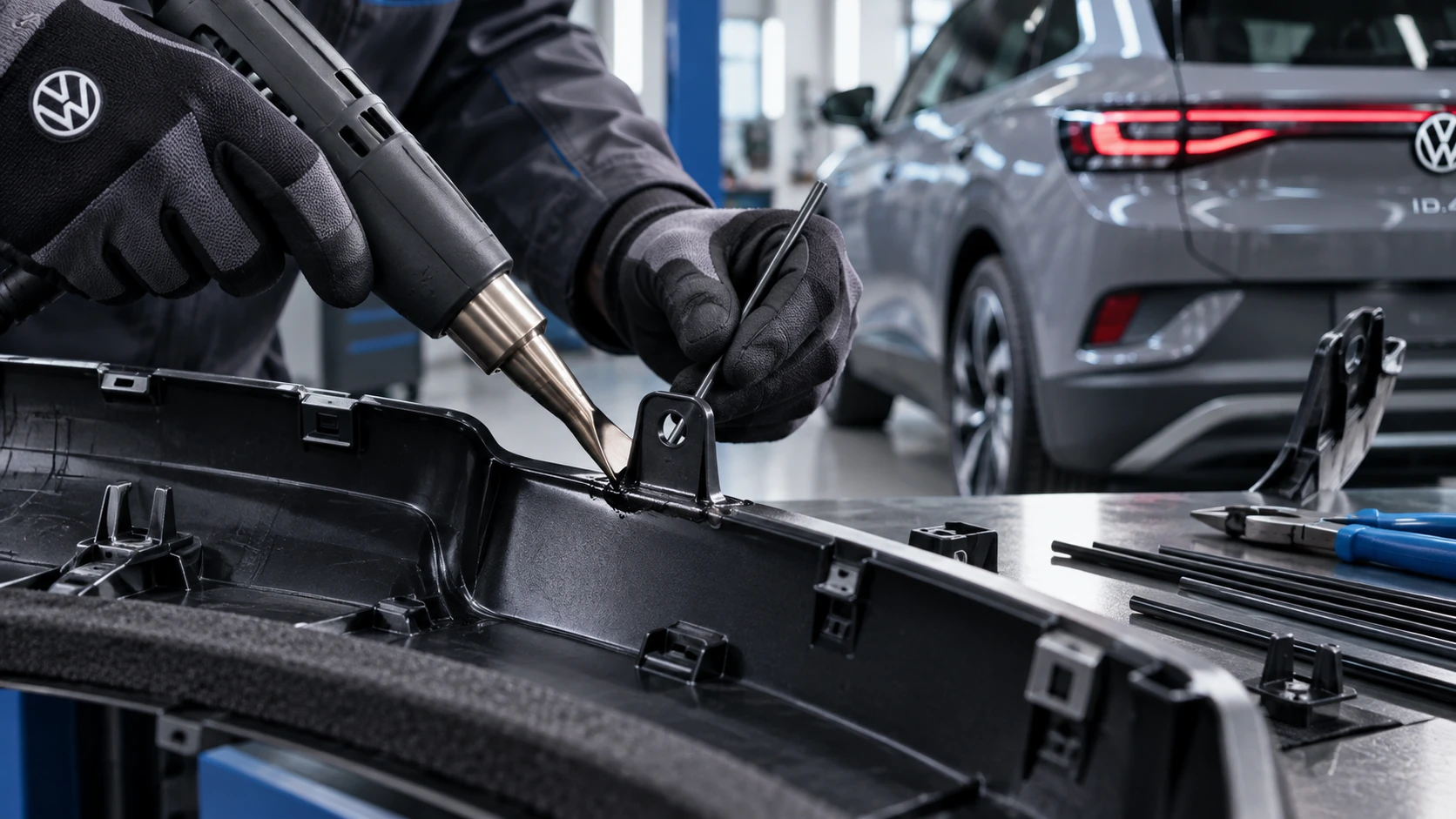
Professional Volkswagen ID.4 repair guidance for welding plastic attachments, securing damaged mounting points and restoring plastic components correctly.
Read guide →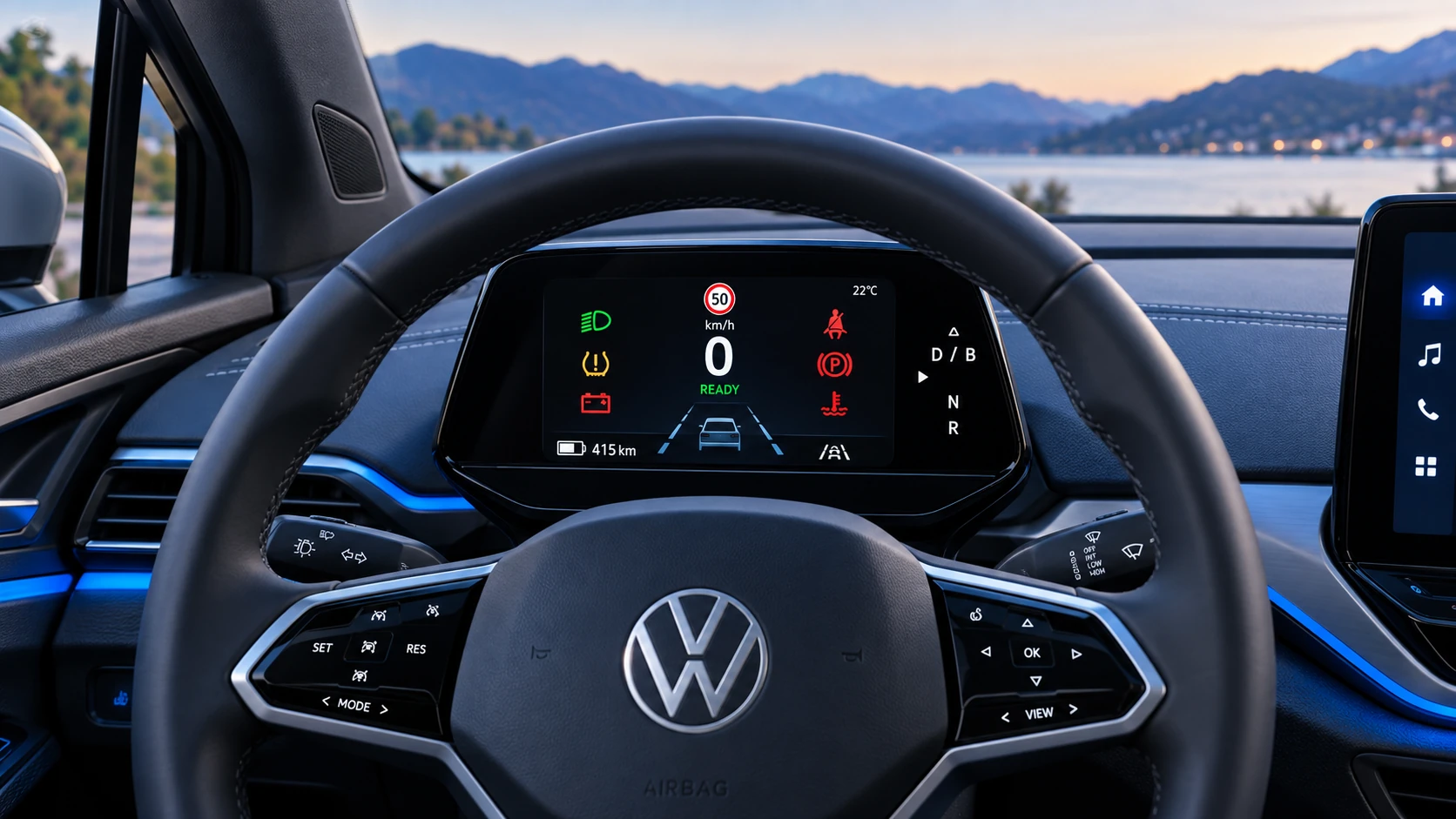 ID.4 Guide
A practical overview of Volkswagen ID.4 instrument cluster symbols, warning lights and status indicators to help drivers understand the display quickly.
Read guide →