Welding Plastic Attachments
Professional Volkswagen ID.4 repair guidance for welding plastic attachments, securing damaged mounting points and restoring plastic components correctly.
Read guide



The Volkswagen ID.4 combines an electric drivetrain, high-voltage battery, regenerative braking, connected software and numerous electronic control systems. This FAQ explains common ownership and technical topics in clear language and helps you find the relevant manual information more quickly.
General questions about the vehicle and its electric architecture.
The Volkswagen ID.4 is a battery-electric SUV developed as part of Volkswagen's ID family of electric vehicles. Unlike a conventional Volkswagen adapted from an internal-combustion platform, the ID.4 was engineered around an electric vehicle architecture.
Its propulsion system combines a high-voltage battery, power electronics, one or more electric drive motors depending on the version, regenerative braking and extensive electronic control.
The ID.4 uses Volkswagen Group's modular electric-drive platform, commonly known as MEB. The architecture was designed specifically for battery-electric vehicles.
One of its defining characteristics is the placement of the high-voltage battery within the vehicle floor. This contributes to packaging efficiency, a relatively low center of gravity and the interior proportions associated with dedicated EV platforms.
No. Specifications and equipment can differ substantially by model year, country, battery version, drivetrain and trim level. Rear-wheel-drive and all-wheel-drive configurations are available in different markets and years.
When using service information, electrical diagrams or operating instructions, always verify that the information applies to the specific vehicle configuration.
The ID.4 does not use a conventional gasoline or diesel engine. Propulsion is provided by an electric drive system powered from the high-voltage battery.
Electric motors operate differently from combustion engines and do not require the same type of multi-ratio transmission used in many conventional vehicles.
Battery operation, temperature, range and long-term use.
The main high-voltage battery is integrated into the vehicle floor structure. This layout keeps a substantial portion of the vehicle's mass low and allows the electric drivetrain to use space differently from a conventional combustion-engine vehicle.
Lithium-ion batteries operate most effectively within an appropriate temperature range. Battery temperature can influence available power, regenerative braking, charging performance and energy consumption.
The ID.4 therefore uses thermal-management systems to control the temperature of important high-voltage components.
The displayed range is an estimate rather than a fixed measurement. It can change as the vehicle evaluates recent energy consumption, ambient temperature, climate-control demand and other operating conditions.
A difference in the indicated range does not automatically mean that the battery has suddenly lost the corresponding amount of usable capacity.
Yes. Low ambient temperatures can increase energy consumption because the battery and passenger compartment may require heating, while battery chemistry itself is also temperature-sensitive.
The effect varies with temperature, trip length, driving style, climate-control use and vehicle configuration.
Charging requirements depend on how and when the vehicle will be used. For routine daily operation, owners should follow the recommendations and charging settings provided for their specific vehicle and software version.
A higher state of charge may be useful before a longer journey, while everyday charging strategies may differ. The applicable owner's manual remains the primary reference.
AC charging, DC fast charging and charging behavior.
With AC charging, alternating current from the charging source is converted by the vehicle's onboard charging equipment before energy is stored in the high-voltage battery.
With DC fast charging, the charging station supplies direct current to the vehicle's high-voltage system. This allows much higher charging power when conditions permit.
Fast-charging power is dynamically controlled. The maximum possible rate depends on battery temperature, state of charge, battery protection limits, charging-station capability and other conditions.
Charging power usually does not remain at its peak value for the entire session. As the battery becomes fuller, the vehicle may reduce charging power to manage battery stress and temperature.
A cold or very warm battery may initially accept less power. Charging speed can also be limited by the charging station, electrical installation, cable, available current or the vehicle's own charging limits.
A single charging session therefore should not be used by itself to judge the condition of the battery or charging system.
The vehicle and charging equipment manage the charging process electronically. Once the selected charging target is reached, normal charging does not simply continue at full power.
Follow the owner's manual and charging-equipment instructions, particularly when using scheduled charging or climate preconditioning.
How an electric ID.4 behaves differently on the road.
During regenerative braking, the electric drive can operate as a generator. Vehicle kinetic energy is converted back into electrical energy rather than being dissipated entirely as heat by the friction brakes.
The actual amount of regeneration available depends on vehicle operating conditions and battery status.
Yes. Regenerative braking works together with the vehicle's conventional braking system. The vehicle coordinates the available regenerative and friction braking to provide the required deceleration.
Conventional brakes remain essential for strong braking, low-speed operation and situations where regenerative braking is limited.
Regeneration may be restricted when the battery is cold, at a high state of charge or when system conditions do not permit full energy recovery.
Because the braking system blends regeneration and friction braking, the exact operating behavior can vary.
Energy use is influenced by speed, acceleration, ambient temperature, heating and air conditioning, road conditions, elevation, tire condition, vehicle load and driving style.
Highway driving at sustained high speeds can use considerably more energy than moderate-speed urban or mixed driving.
Electronic systems, displays, connectivity and diagnostics.
Many ID.4 functions are coordinated electronically, including high-voltage energy management, charging, climate control, infotainment, driver assistance and numerous body systems.
As a result, vehicle behavior can depend not only on physical components but also on control-module software and configuration.
Software updates can alter supported functions, user-interface behavior or control strategies depending on the update and vehicle configuration.
This is one reason instructions or screen layouts can differ between otherwise similar Volkswagen ID.4 vehicles.
Warning messages should be interpreted according to their wording, symbol and priority. Some indicate informational conditions, while others require immediate attention.
Use the corresponding warning and indicator section of the owner's manual rather than diagnosing a fault solely from the symbol itself.
Manuals may cover several equipment levels, markets and production versions. Optional equipment and software-dependent functions are not necessarily installed on every vehicle.
Always compare the manual information with the actual vehicle equipment and model year.
Using the Volkswagen ID.4 owner and workshop information correctly.
The owner's manual explains vehicle operation, controls, displays, charging, safety information and features intended for normal vehicle use.
A service or workshop manual contains more technical information such as component locations, removal and installation procedures, repair instructions and system-specific service information.
High-voltage vehicle systems require specialist knowledge, appropriate procedures and safety precautions. Service information should not be interpreted as permission to perform high-voltage work without the required training and equipment.
Procedures involving high-voltage components should be carried out only by appropriately qualified personnel.
Vehicle repairs are often interconnected. Accessing one component may require removal of trim, electrical connectors or adjacent parts, while final assembly may require calibration, testing or additional checks.
For this reason, a single manual page should be read together with the related procedures it references.
Start with the relevant system or component category in the Volkswagen ID.4 service manual. Component names are generally more useful search terms than describing the symptom alone.
You can also use the site navigation and search to locate removal, installation, inspection or system-description pages.
No. VW-ID4.com is an independent informational resource intended to help users navigate and understand Volkswagen ID.4 manual material.
Vehicle-specific repair requirements, safety instructions, technical updates and official procedures should always be verified using the appropriate information for the exact vehicle.
Selected owner and service information from our Volkswagen ID.4 manual library.
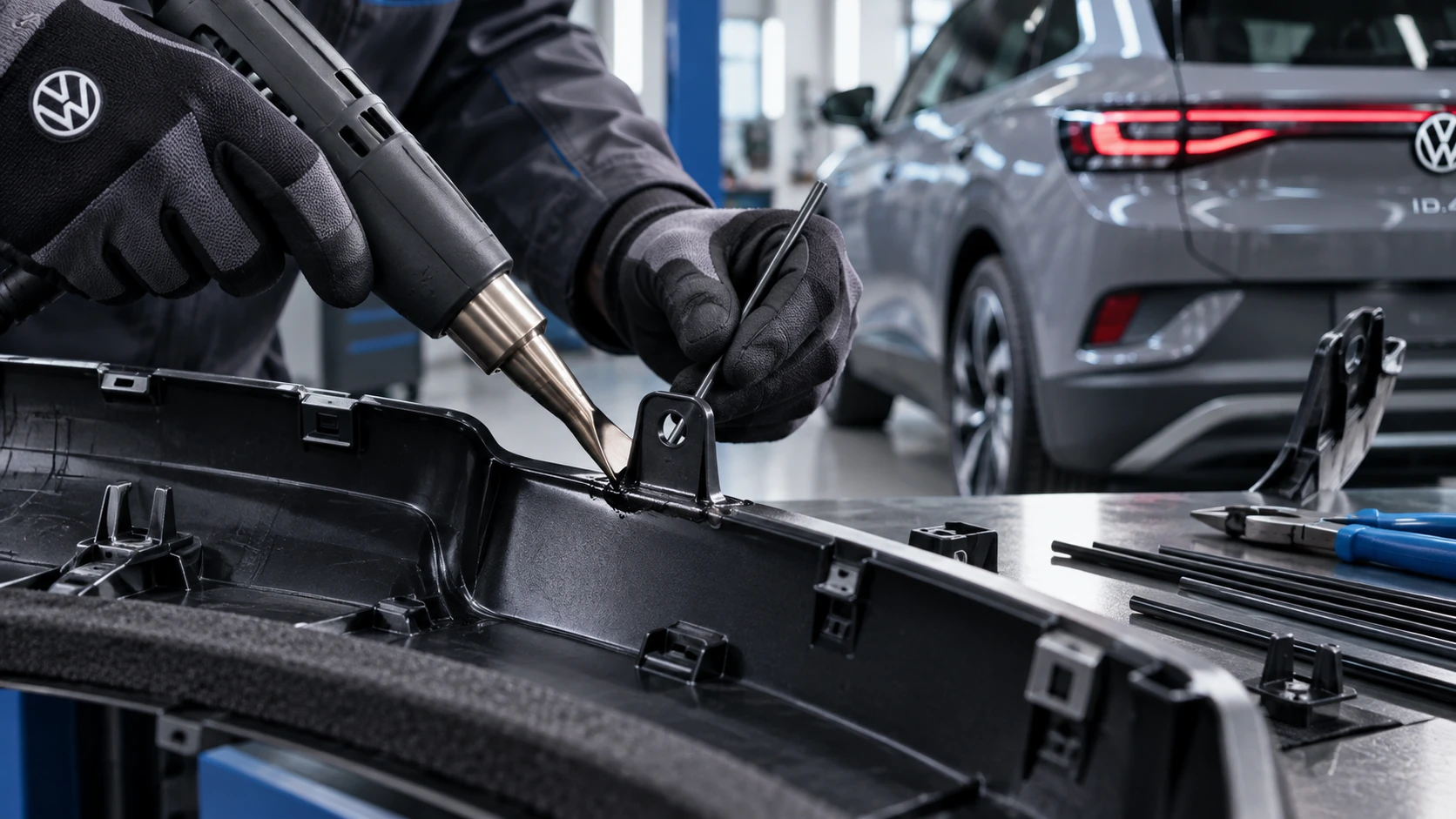 ID.4 Guide
Professional Volkswagen ID.4 repair guidance for welding plastic attachments, securing damaged mounting points and restoring plastic components correctly.
Read guide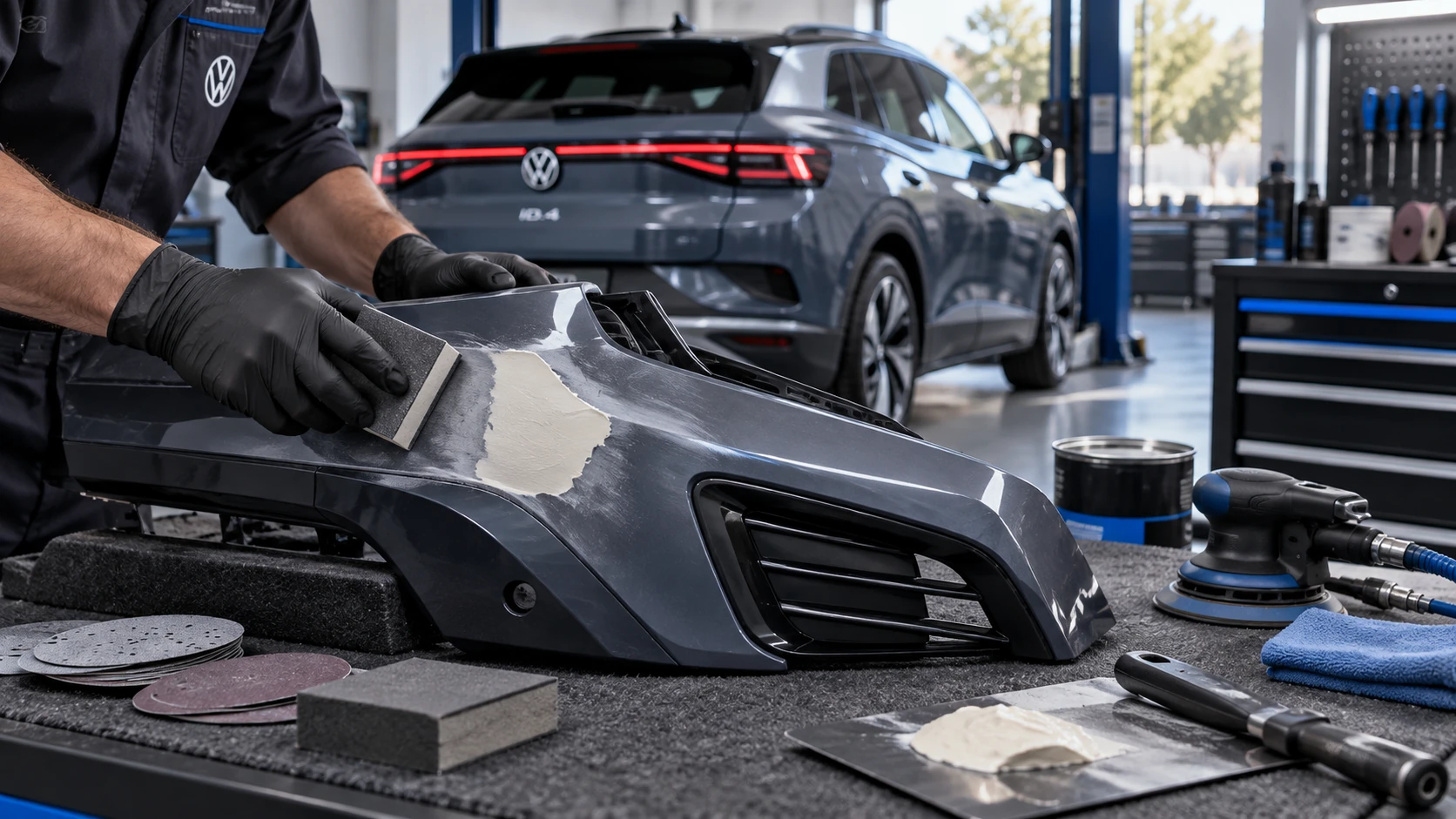 ID.4 Guide
Volkswagen ID.4 plastic repair procedures covering surface preparation, filler work, sanding and restoration of damaged plastic exterior components.
Read guide